The Unexpected Triage
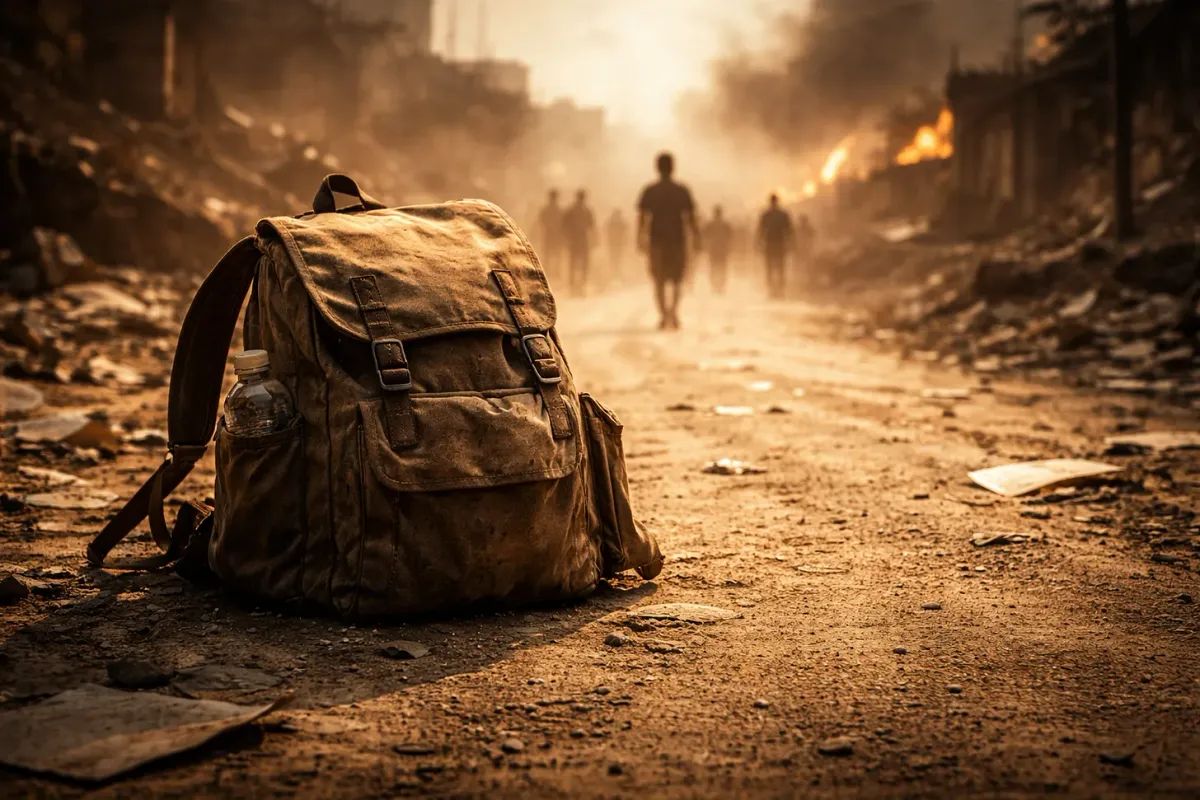
Imagine that, without warning, you are told that you must leave your home forever.You have one hour. Nothing more.
In that hour, you must decide what to take with you on a journey whose destination you do not know. Every object suddenly carries weight. Not physical weight alone, but emotional and symbolic weight as well.
Do you take documents that may determine your future?
A warm jacket that might protect you from the cold?
Or photographs that preserve the memories of the life you once lived?
Within sixty minutes, you are forced to decide what truly matters.
Most people would treat this question as hypothetical. Yet imagine that it is real. Imagine standing in your room, looking at the objects around you, knowing that you may never see them again.
In such moments, something interesting happens: life demands a form of triage.
In medicine, triage is a fundamental principle. In a crowded emergency department, when resources are limited and patients arrive simultaneously, physicians must quickly determine who needs help first. We assess urgency, severity, and survival chances. The goal is simple but difficult: to focus on what matters most, because time and resources are limited.
Triage is not about choosing what we like most.
It is about identifying what is most essential.
The same principle appears in life when circumstances suddenly strip away the illusion of abundance.
The year was 2014 when war reached my city. One day I received a message from my brother: we had to leave within hours. Perhaps forever.
In that moment, my entire life was reduced to the contents of a backpack.
Suddenly the same question physicians face in an emergency department appeared in my own life:
What is most important right now?
Money seemed meaningless.
Objects lost their certainty of value.
Should I take a thick jacket for the cold, or my academic certificates for the future?
Were identification documents more important than family photographs?
Each item competed for space, and each decision felt irreversible.
This was my personal triage.
“No one leaves home unless home is the mouth of a shark.”
— Warsan Shire
But unlike in medicine, where decisions rely on clinical criteria, life’s triage reveals something deeper: our values.
Different people would choose different things.
Some might take a collection they cherish.
Others a handwritten love letter.
Perhaps a gift from grandparents carrying generations of memory.
What we choose says something about who we are.
As my brother and I left the city, backpack on my shoulders, another realization slowly appeared: I had forgotten many things.
With every step away from home, a mental list grew longer. Documents. Personal items. Practical tools. Memories.
But distance changes perspective.
Over the years that followed, my understanding of what truly matters shifted dramatically. Things that once seemed indispensable lost their importance, while other aspects of life became central.
Loss has a strange ability: it clarifies.
The experience taught me something medicine had already hinted at, triage is not only a medical principle. It is a life principle.
We live as if everything around us matters equally. But when time becomes limited, when uncertainty enters the room, we suddenly see clearly.
Family.
Friends.
Health.
Human connection.
These rarely fit into a backpack, yet they carry the greatest weight in our lives.
Moments of crisis function like an alarm clock. They force us to re-evaluate our priorities and focus on what truly makes life meaningful.
My story is not meant to diminish the enjoyment of life or the beauty of possessions. Instead, it is an invitation to reflect.
Because one question remains:
If you had only one hour, what would you take with you?
And perhaps the more important question:
What should matter to you long before that hour ever comes?
This is the first essay of The Anatomy of Survival, where I write about medicine, war, trauma, and the fragile patterns that shape human life.
Comments ()