What Makes Things Valuable? Why Meaning Matters More Than Material
“What is essential is invisible to the eye.”—Antoine de Saint-Exupéry
In my previous essay, The Unexpected Triage, I described how moments of crisis can suddenly reveal what truly matters. When time becomes limited and life is reduced to a few essential decisions, many things that once seemed important quietly lose their significance.
But this experience raises another question: what actually makes something valuable in the first place?
This question has been with me for as long as I can remember. As a child, I often asked my father a simple question: Why is gold valuable? After all, it is just a metal. It does not feed us, it does not heal us, and it does not think. Yet people have treasured it for thousands of years.
The answers I received explained rarity, tradition, or usefulness, but none of them fully satisfied my curiosity. Something about the concept of value itself seemed more complex.
Over time, I began to see value not as something inherent in objects, but as something that emerges from meaning.
Value theory often explains value through usefulness or scarcity. Philosophers and economists have long argued that things become valuable because they serve a function or because they are rare. Yet many of the things we consider most valuable, such as memories or relationships, cannot be measured in this way. Their importance does not arise from material properties alone, but from the meaning and perception we attach to them.
Gold is valuable not only because of its physical properties, but because humans collectively agreed that it has value. The same applies to many things in life. Money, art, status, and even traditions have no intrinsic meaning outside of human perception. They become valuable because we assign importance to them.
“Beauty in things exists merely in the mind which contemplates them”
— David Hume
But this leads to a deeper question: if value is given, what guides us when we give value? Why do we consider some things meaningful while ignoring others?
Part of the answer may lie in survival. Throughout human history, things that helped us survive became valuable: food, shelter, tools, and social bonds. Over time, however, our definition of value expanded beyond pure survival. Humans began to value beauty, symbolism, knowledge, and ideas. These things cannot always be measured, yet they shape civilizations.
Value is therefore not fixed. It evolves as human consciousness evolves. What one generation considers precious, another may consider unimportant.
Moments of crisis make this question tangible. When a person is forced to leave their home, the abstract idea of value suddenly becomes concrete. With limited time and space, the question what is valuable? is no longer theoretical, it becomes deeply personal.
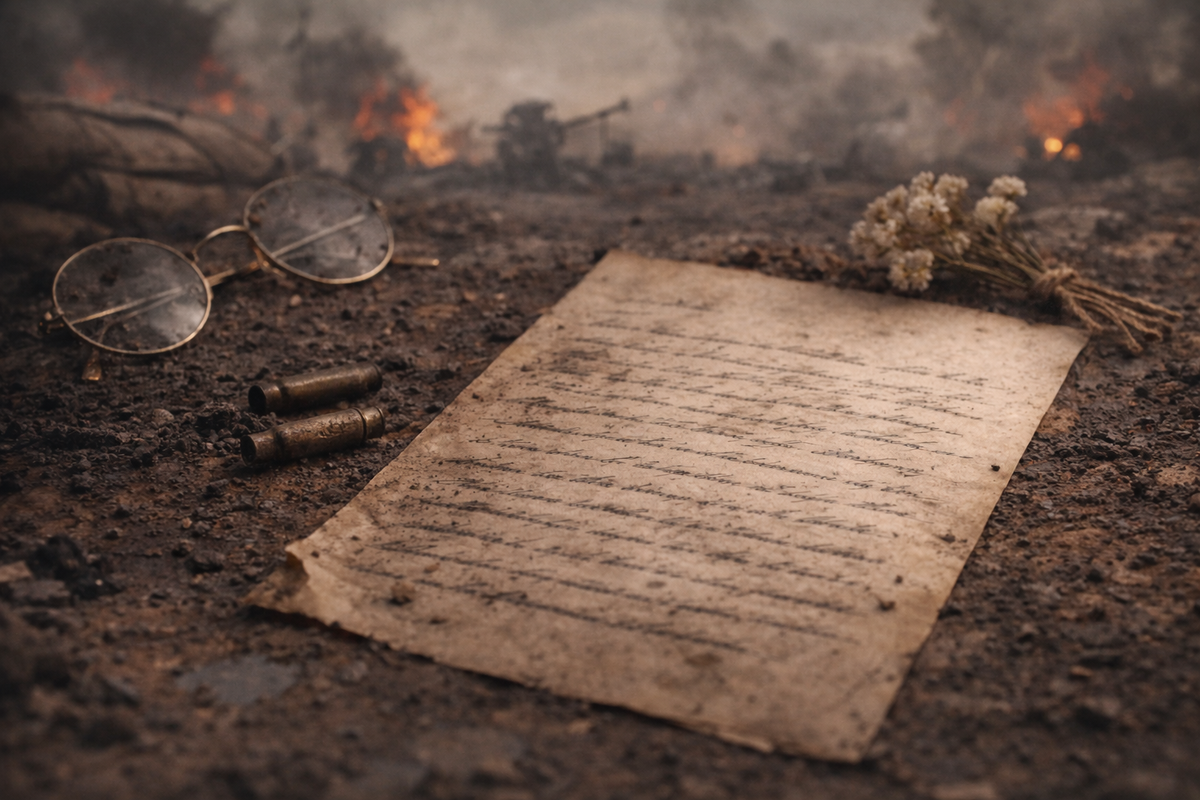
In such moments, many objects reveal their true nature. A letter from a grandmother is, in physical terms, nothing more than paper with ink.It may not be gold, yet it is rare in its own way. As the only letter from a grandmother, it holds a value that cannot be replaced.
Its value does not lie in the material itself, but in the meaning attached to it. The letter represents memory, connection, love, and identity. Without human interpretation, it would simply remain paper.
Value is therefore not simply a property of objects. It is created through human experience. What appears insignificant from a material perspective can become priceless once it is connected to memory or emotion.
This perspective also applies to everyday life. Humans constantly assign meaning to experiences.
Sometimes, a single word spoken by someone we love can affect us for days, months, or even years. From a purely physical point of view, it is only a sound that disappears the moment it is spoken. Yet its emotional impact can shape decisions, relationships, and even the direction of a life.
Why can something so small feel so powerful?
Because our mind does not only perceive reality; it interprets it. The brain continuously assigns meaning to experiences. A word becomes painful not because of its physical form, but because of the significance we attach to it. The context, the relationship, and the memories connected to the moment all shape the meaning we create.
Meaning and value strengthen each other.
Understanding this can be both challenging and liberating. If we are capable of assigning meaning, we may also be capable of reshaping it.
The question that began in childhood, why is gold valuable? ultimately leads to a broader reflection: value does not exist independently of us. It is shaped by human perception, needs, and imagination.
In the end, value is less a property of things and more a reflection of the meaning we create.
Comments ()